Monday, March 31, 2008

Sunday, March 30, 2008
Monday, March 24, 2008
Saturday, March 22, 2008
Chesterton in Spanish 2

A Prayer in Darkness
G.K.Chesterton
- This much, O heaven--if I should brood or rave,
- Pity me not; but let the world be fed,
- Yea, in my madness if I strike me dead,
- Heed you the grass that grows upon my grave.
- If I dare snarl between this sun and sod,
- Whimper and clamour, give me grace to own,
- In sun and rain and fruit in season shown,
- The shining silence of the scorn of God.
- Thank God the stars are set beyond my power,
- If I must travail in a night of wrath,
- Thank God my tears will never vex a moth,
- Nor any curse of mine cut down a flower.
- Men say the sun was darkened: yet I had
- Thought it beat brightly, even on--Calvary:
- And He that hung upon the Torturing Tree
- Heard all the crickets singing, and was glad.
Spanish translation:
Una oración en las tinieblas
O cielo si me enturbiara o me enojara
No te apiades tanto de mí mas deja que el mundo se sustente
Y si en mis desvaríos acaso me matara
Sólo cuida la hierba que crece sobre mi túmulo
Si me atreviera a hacer mala cara entre este sol y avena, llanto y clamor
Dame la gracia bajo el sol y la lluvia y la fruta en estacíon
Para sufrir el brillante silencio del escarnio de Dios.
Gracias a Dios que los astros estén fuera de mi alcance
Gracias a Dios que mis lágrimas no ahoguen polilla alguna
Ni mis conjuros corten flores
Si tengo acaso que pasar noches de ira.
Dicen que en aquel instante el sol se oscureció
Mas pensé que brillaba intensamente
Aún en El Monte Calvario
Y él que colgaba del árbol tormentoso
se halló contento . . .
al escuchar el canto de los grillos.
Chesterton in Spanish 1

To Edmund Clerihew Bentley

 A cloud was on the mind of men, and wailing went the weather,
 Yea, a sick cloud upon the soul when we were boys together.
 Science announced nonentity and art admired decay;
 The world was old and ended: but you and I were gay;
 Round us in antic order their crippled vices came--
 Lust that had lost its laughter, fear that had lost its shame.
 Like the white lock of Whistler, that lit our aimless gloom,
 Men showed their own white feather as proudly as a plume.
 Life was a fly that faded, and death a drone that stung;
 The world was very old indeed when you and I were young.
 They twisted even decent sin to shapes not to be named:
 Men were ashamed of honour; but we were not ashamed.
 Weak if we were and foolish, not thus we failed, not thus;
 When that black Baal blocked the heavens he had no hymns from us
 Children we were--our forts of sand were even as weak as eve,
 High as they went we piled them up to break that bitter sea.
 Fools as we were in motley, all jangling and absurd,
Spanish translation:
A Edmund Clerihew Bentley
Una nube posaba sobre la mente de los hombres
Y el tiempo deliraba
Sí, una nube enfermiza posaba sobre el alma cuando éramos chavales juntos
La ciencia anunció la no-entidad y el arte admiraba la podredumbre
El mundo estaba viejo y se acabó,
Pero tú y yo estábamos alegres
Sus voces roncas nos ceñían en orden travieso
Una lujuria que había perdido su risa,
Un temor que había perdido su vergüenza,
Como la trenza cana de Whistler que nos alumbraba la lugubrez sin rumbo.
Los hombres mostraba su propio plumaje tan orgullosamente como un plumete
La vida fue una mosca que se desvanecía
Y la muerte un zángano que picaba.
De verdad, el mundo estaba muy viejo cuando éramos jóvenes, tú y yo.
Transformaban hasta el pecado decente en figuras que no cabe nombrar.
Los hombres se avergonzaban del honor pero nosotros no.
Si fuimos débiles y tontos así no hemos errado, así no.
Cuando ese negro Baal bloqueaba los cielos no le venían himnos de nosotros.
Eramos niños, nuestros castillos de arena estaban tan flacas como la tarde
Ascendían a lo alto, así los construimos para romper el mar amargo.
Tontos como éramos en compañía, completamente gafes y absurdos . . . .
Wednesday, March 19, 2008
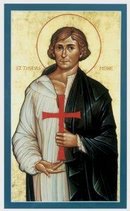
Erasmus and Thomas More

(The previous section discusses the cult of the martyred bishop St. Thomas Beckett)
So the name of Thomas was explicable, but the origins of his surname cannot be so easily discovered. If such names derive from some sense of place, then the great moors or marshes around London might find an echo here. It is also a name upon which a number of puns were constructed. 'More' could be the 'Moor' or black Ethiop and Desiderius Erasmus, the Dutch humanist who became his close companion, sometimes called him 'Niger'.
(from the Life of Thomas More by Peter Ackroyd 1998, p.5)
Oh, that Erasmus! This is the same man who said: "Pray for us St. Socrates."
I can see it know:
More: What up Desi?
Erasmus: Hey Thomas, you know you my N-word.
Subscribe to:
Posts (Atom)